
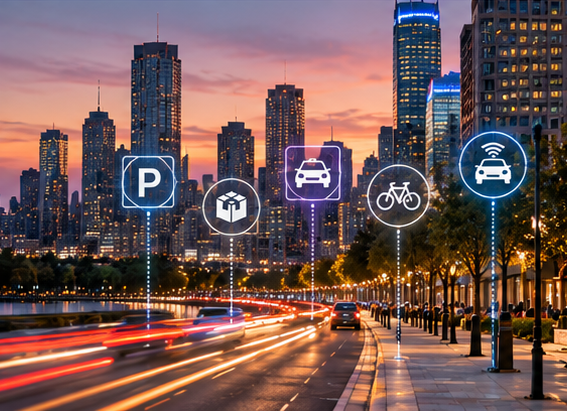


The curb has become one of the most valuable and contested parts of the urban transportation network and has undergone significant changes in recent years.
What was once primarily a place for parking now needs to accommodate commercial deliveries, rideshare pickups, food delivery, micromobility, loading zones, bike infrastructure, and autonomous vehicles in addition to traditional parking; often on the same block and at different times of day.
The webinar, The Next Frontier in Curb Management, explores how cities can respond to this changing environment by moving beyond static signs and traditional parking management toward a more digital, data-driven, and flexible curb ecosystem. The session examines the current state of curb management and the technologies and practices shaping its next generation.
The Curb Is Changing Faster Than Ever
The way people and goods move through cities has changed dramatically. E-commerce and food delivery have grown, rideshare has reshaped pickup and drop-off activity, and newer modes such as cargo bikes, delivery robots, micromobility, and autonomous vehicles are creating additional demand.
Yet much of the curb is still managed through physical signs, meters, and regulations that can be difficult to interpret and even harder to update quickly.
One solution is digitizing curb inventory and right-of-way management. By creating digital representations of parking, loading zones, pickup areas, restrictions, and other curb policies, cities can better understand what exists and how it is being used. Real-time occupancy data and modeled predictions can add another layer, helping agencies compare demand across blocks and neighborhoods and make more informed policy decisions.
For digital curb information to become a true source of operational truth, however, the webinar emphasizes the need for “operations-grade” data that stays accurate and current as signs, meters, and policies change.
From Reactive Management to Data-Driven Operations
Digitization is only the beginning. The next frontier is using data to make curb operations more proactive.
Instead of relying on observations that a particular block “looks busy,” agencies can use occupancy, payment, compliance, and demand data to determine where resources are needed, when enforcement should occur, and how curb space is performing.
Automation can extend those capabilities further. Camera-based systems can continuously monitor curb activity and support automated pricing, payments, and enforcement based on how a zone is being used. This gives cities better visibility into compliance while reducing dependence on having enforcement personnel physically present at every location.
The webinar highlights measurable results from these approaches, including reductions in double parking of more than 95% in some scenarios and increases in turnover of around 70%. Better compliance can also make commercial loading zones more available for the drivers who actually need them.
Preparing the Curb for Autonomous Vehicles
Autonomous vehicles introduce another challenge: traditional curb systems were designed around human drivers.
A driver can read a sign, open a parking app, enter payment information, or move after receiving a citation. A driverless vehicle requires a different model.
As autonomous vehicles and automated delivery fleets expand, cities will need systems capable of communicating rules and handling transactions digitally. The webinar points toward machine-to-machine payments, automated commercial loading zones, digital curb policies, and automated compliance as important components of that future.
This also raises a broader question about curb economics. Cities must consider not only how new mobility services use limited curb space, but also how they pay for that use and contribute to sustainable transportation programs.
The Implications of Moving from Parking Management to Mobility Management
Technology alone won’t complete the transition to a digital and mobility-based approach. Agencies also need to prepare their workforce, rethink operational roles, and involve the right stakeholders when developing policies. The webinar notes that adopting new technology can outpace staff training and that policy changes can affect enforcement, courts, staffing, payments, and other parts of city government.
The next frontier, is not simply a smarter parking space. It is a dynamic, digitally managed curb that can adapt to changing demand, improve safety and access, support new mobility modes, and help cities make better use of one of their most valuable public assets.