
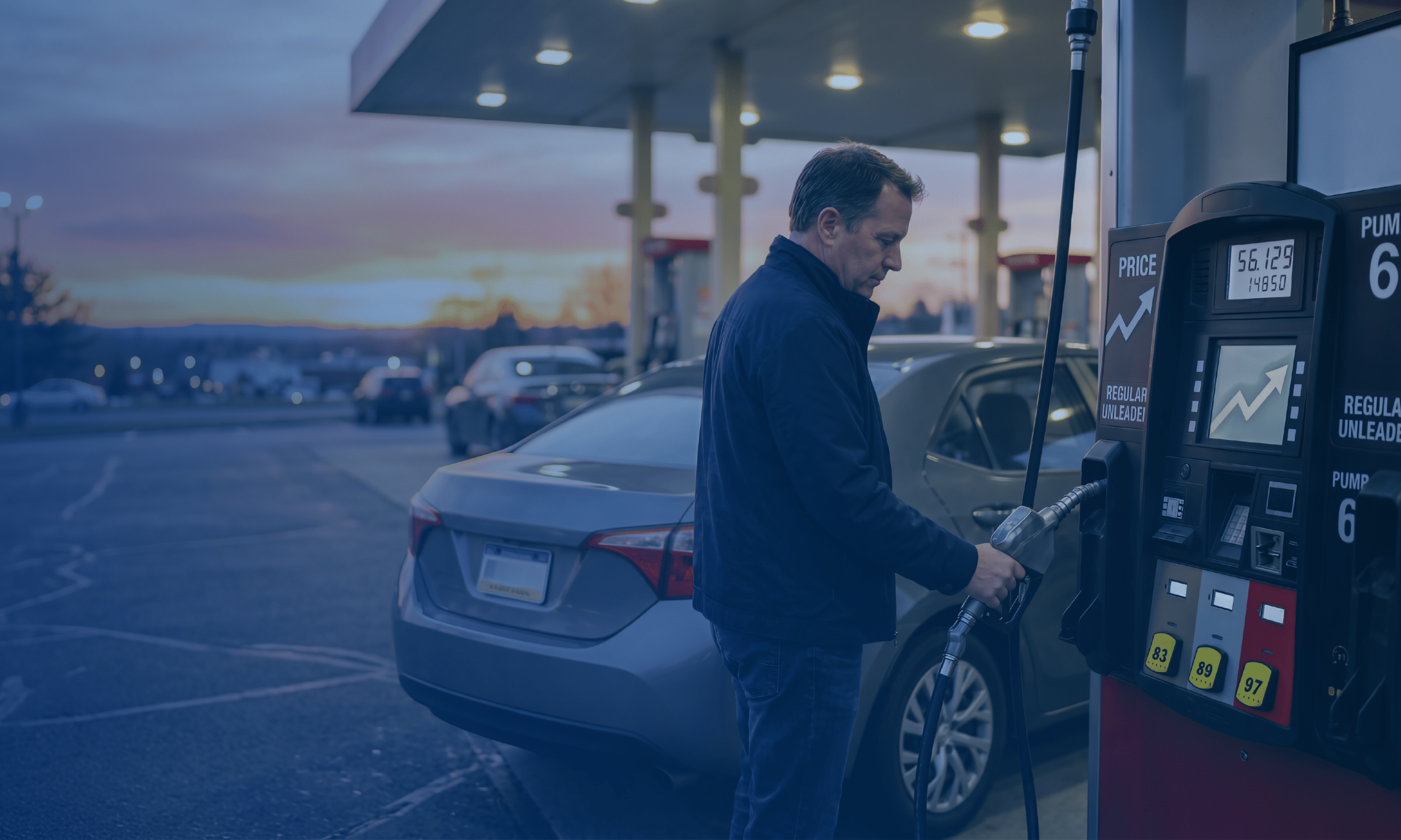


Rising fuel costs often trigger two common responses: drivers look for fewer miles to drive, and they look for ways to make each mile cheaper.
Guidance from the RAC explicitly points to speed choice as a lever, stating that excessive speed is a major factor reducing fuel economy and noting that driving below the limit “isn’t a target”. Against that background, new analysis from INRIX indicates that, so far in 2026, we still have no evidence of a broad behavioral shift in either the United Kingdom or the United States in the measures we would expect to move first (speeds in uncongested conditions, trip volumes, and distances driven).
What We Are Seeing in the Data
In the UK, the most direct “early warning” signal we have been watching is motorway speed choice under free-flow conditions. In 2022, a measurable slowdown first emerged on a section of the M5 motorway during a period of record high prices. In the latest “Daily Speed Summary” for that same section, there is no comparable step-change: average speeds remain within the range of normal variation, rather than showing a persistent drop consistent with widespread fuel-saving driving.
We are also not seeing evidence of drivers suppressing travel demand — discretionary travel often shows up clearly. Over the Easter holiday period, UK-distance indicators show no meaningful reduction in how far people drove compared with what seasonal patterns would typically suggest, and the same overall 5% drop in total miles driven (as holiday trips are outweighed by lower commuter volumes) that we observed over Easter 2025.
In the US, our latest comparisons also show no change detected in the two mobility measures that most cleanly reflect behavioral adjustment: trip counts and driving speeds. Across the current period, trip totals and average speeds remain broadly aligned with expected weekly patterns, rather than showing a sustained, price-driven pullback.
The Benchmark Year When Fuel Prices Did Change Behavior
The reason we are treating the current “no change detected” outcome as noteworthy is that we have seen a clear, coincident response before—when prices crossed especially salient thresholds.
In the US, the clearest example is mid-June 2022. In our weekly national mobility series, we observed an approximate 2–3% drop in overall road use (as measured by total kilometers travelled / trip totals) in the same window that the national average retail price for regular gasoline reached about $5 per gallon—a level the US hit briefly and then moved away from. The U.S. Energy Information Administration’s weekly series shows regular gasoline at $5.006/gal on June 13, 2022, with surrounding weeks below that level.
In the UK, July 2022 provides a parallel reference point. Official weekly pump-price data from the Department for Energy Security and Net Zero show UK averages peaking at 191.55p/liter for petrol and 199.22p/liter for diesel in the week commencing July 4, 2022. During that period, INRIX analysis previously identified a motorway free-flow slowdown consistent with drivers adjusting behavior to reduce fuel consumption.
Taken together, these two “2022 moments” look like examples of a behavioral tipping point: prices not only rose but reached levels that were simultaneously unusually high in absolute terms, and highly salient in public attention.
Fuel Price Context in 2026: Sharp Rises, But Not the Same Threshold
It is important to acknowledge that fuel prices in 2026 have risen quickly in both countries—yet our observed behavior signals have not followed in the same way.
In the UK, DESNZ weekly averages rose from 131.71p/liter (petrol) and 141.46p/liter (diesel) in the week commencing February 23, 2026, to 154.65p/liter and 186.75p/liter respectively in the week commencing April 6, 2026. That is a large move over a short period, but it is still short of the July 2022 peak—especially for petrol (154.65p vs 191.55p).
In the US, the EIA’s series similarly shows regular gasoline rising from $2.937/gal (week ending February 23, 2026) to $4.120/gal (week ending April 6, 2026). That is a steep increase, but it remains below the June 2022 $5.006/gal peak in the same series.
This “below peak but sharply rising” pattern is consistent with what we are seeing in the mobility data: price pressure is building, but the behavioral response that appeared at the 2022 extremes has not yet re-emerged.
Why a Behavioral Tipping Point is a Plausible Interpretation
What does it mean to say there is a “tipping point” here? The most careful way to frame it is as a hypothesis supported by three overlapping strands of evidence: (1) how travel demand typically responds to fuel prices, (2) the special role of salience and thresholds, and (3) the time needed for households to translate price signals into action.
First, most research finds that fuel-price impacts on driving are real but often modest in the short run—until costs become hard to ignore. A major US economics working paper widely cited in the field concludes that short-run gasoline demand can be quite inelastic (i.e., not very responsive) in modern periods, with estimated short-run price elasticities far smaller than those found in earlier decades. UK government evidence also treats behavioral changes like speed choice as one of the mechanisms by which price can affect travel outcomes, but notes that elasticities vary substantially by trip purpose and that long-distance holiday travel can be among the most price-sensitive categories in some studies. The absence of visible change in our UK Easter-distance indicators—when holiday travel would be the “most likely” to soften if it were going to—supports the idea that the current price regime may not have crossed the practical threshold that triggers action at scale.
Second, thresholds matter because people do not experience prices only as mathematics; they experience them as signals. In June/July 2022, both countries hit values that were easy to recognize as exceptional: the US briefly crossed $5/gal on the national average, and the UK hit record highs around (and above) 190p/liter. Those are the kinds of headlines that can turn a gradual cost increase into a moment where households collectively say, “this is different.” In 2026, even with rapid rises, national averages have not yet reached those same symbolic peaks.
Third, persistence is critical. Many travel decisions are “sticky” week-to-week—commutes, school runs, caring responsibilities, and pre-booked trips. This is one reason price effects can emerge more clearly after prices stay elevated long enough for people to plan alternative routines (combining trips, rescheduling discretionary travel, changing mode where possible). The UK government evidence assessment also highlights how improvements in fuel efficiency can dampen the reduction in car travel from higher fuel prices (a form of “rebound effect”), which can further delay or dilute the behavioral signal in aggregate data.
Put simply: 2022 looked like a moment when price levels were high enough, salient enough, and sustained enough to trigger measurable behavior change—while 2026, to date, looks like a period of sharp price movement without the same broad behavioral tipping point being crossed. This is a hypothesis, not a certainty, and it is exactly why continued monitoring matters. Looking ahead, the key question is whether today’s rapid increases become persistent—and whether they move closer to the kinds of record or psychologically salient levels that previously coincided with behavior change.