



When shared bikes and scooters show up consistently—at the right density, in the right places—they become a reliable choice.
That reliability is what turns “something you try once” into “something you count on” for a commute, an errand run, or a transit connection.
But reliability can look very different depending on where you live and the size of your transportation budget. If vehicles don’t get deployed and rebalanced in neighborhoods that need affordable, flexible options most, usage patterns will naturally skew toward higher-demand cores—and the program will look successful while still missing its equity goals. In addition, pricing needs to meet people at a point where they can afford to use the system regularly.
This blog briefly summarizes the state of micromobility equity programs and new functionality in Ride Report for cities to be able to better evaluate and adjust those programs.
City Agency Equity Requirements
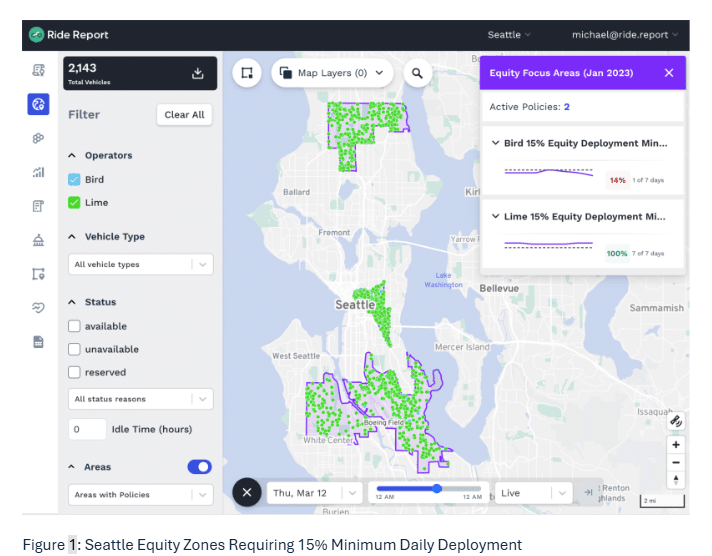
Many agencies specify minimum deployment rules—either as a percentage of daily fleet, a minimum number of devices per equity zone, or a minimum number of vehicles placed within a defined geography. The goal is straightforward: ensure baseline availability where the market wouldn’t necessarily optimize on its own and/or where transportation has been historically underserved. Some examples include:
- Seattle, WA: in addition to deployment requirements in underserved neighborhoods and reduced fare programs, the program takes into account trips taken in targeted neighborhoods when considering fleet cap increases
- Durham, NC: operators are required to have a percentage of scooters and bikes available in equity areas
Access programs
Even when deployments are equitable, pricing can still be a barrier. For that reason, many cities require operators to offer free or reduced fares for qualifying residents and workers—often called “access programs.”
These programs show up in a few forms: discounted memberships, discounted per-minute rates, ride credits, fee waivers, and options for people without bank accounts or smartphones. Sometimes they’re subsidized by public agencies; other times they’re delivered as part of an operator’s required amenities or negotiated fees. Examples include:
- Portland, OR (BIKETOWN for All): Low income and free passes subsidized by the signature sponsor, Nike.
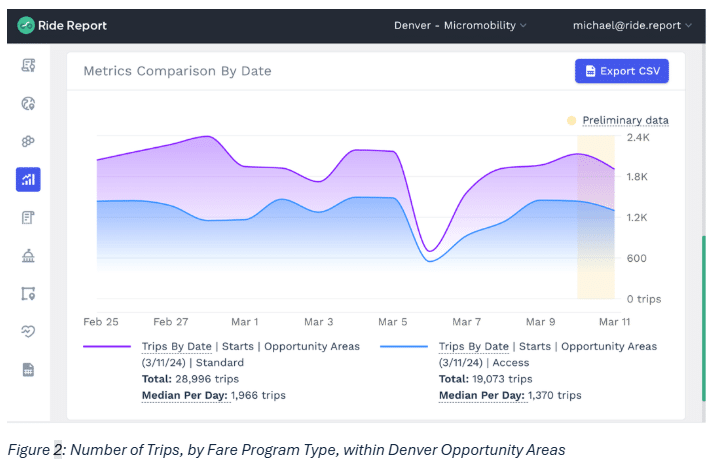
- Denver, CO (value exchange + geographic equity areas): Denver’s shared micromobility program has historically been structured as a “value exchange” (no application, permit, licensing, or per-trip fees), paired with operational requirements—including equity-focused service expectations such as a minimum number of free and reduced fare passes given out to residents.
Data analysis to date
Cities rely on the Mobility Data Specification (MDS) to assess compliance with permit requirements like minimum deployments and to understand resulting trip volumes. MDS makes it possible to monitor operations with a consistent framework, and tools like Ride Report can help agencies turn that data into action.
MDS does not include user-level information. That’s a good thing from a privacy standpoint, but it also means cities cannot get the same level of granular insight on trips using reduced or free fares versus general ridership as a whole. It is all lumped together.
Operators often share aggregate counts (total trips, total usage) outside of MDS, but those summaries still don’t give agencies a consistent way to evaluate equity programs over time and across geographies.
Introducing Fare Program Metrics in Ride Report
In close collaboration with operators and cities, Ride Report is introducing Fare Program Metrics. Since Ride Report was built with privacy-by-design principles, metrics are aggregated by geography and/or over time so individual movements can’t be determined. This opens the path for providing metrics for without compromising privacy, especially for larger access programs.
New capabilities of this feature include:
- More fine-grained program evaluation:
- Review trip start and end locations for access program usage by neighborhood or areas of interest.
- Understand differences in trip distances and durations between access-program trips and the overall riding population.
- Identify preferred facilities used by access riders to better connect equity outcomes to investments in dedicated and protected bike/scooter infrastructure.
- Fee and subsidy handling: waive per-trip fees or add per-trip subsidies for trips made using reduced or free pricing.
- Continuous improvement: cities can adjust requirements and metrics over time—using the same feedback loop they apply to broader program performance—so equity expectations evolve alongside operations.
“The Denver Regional Council of Governments (DRCOG) brings local governments together to address regional issues, including transportation and mobility. Providing access to shared micromobility services is a priority across the Denver region, and in recent years, local jurisdictions have worked closely with partners to expand access to shared micromobility services through efforts such as reduced fare membership programs. To fully understand the impact of these programs, public agencies need intuitive tools that turn data into actionable insights to more effectively evaluate program performance and improve decision‑making. “-Emily Lindsey, Program Manager, Active and Emerging Mobility, Denver Regional Council of Governments
Conclusion
Effective equity programs are built on operational clarity and mutual trust: cities setting clear goals, operators delivering service consistently, and shared measurement that supports learning without compromising privacy. This results in enhanced mobility options for a wide range of residents and workers.
The Fare Program Metrics feature is possible because of long-standing relationships between operators, local agencies, and Ride Report. The result is a more practical way to measure what matters—availability, affordability, and outcomes—while staying true to privacy-first data principles. Thanks to our partners in this first implementation: The City and County of Denver, Denver Regional Council of Governments, Lime, and Bird.