
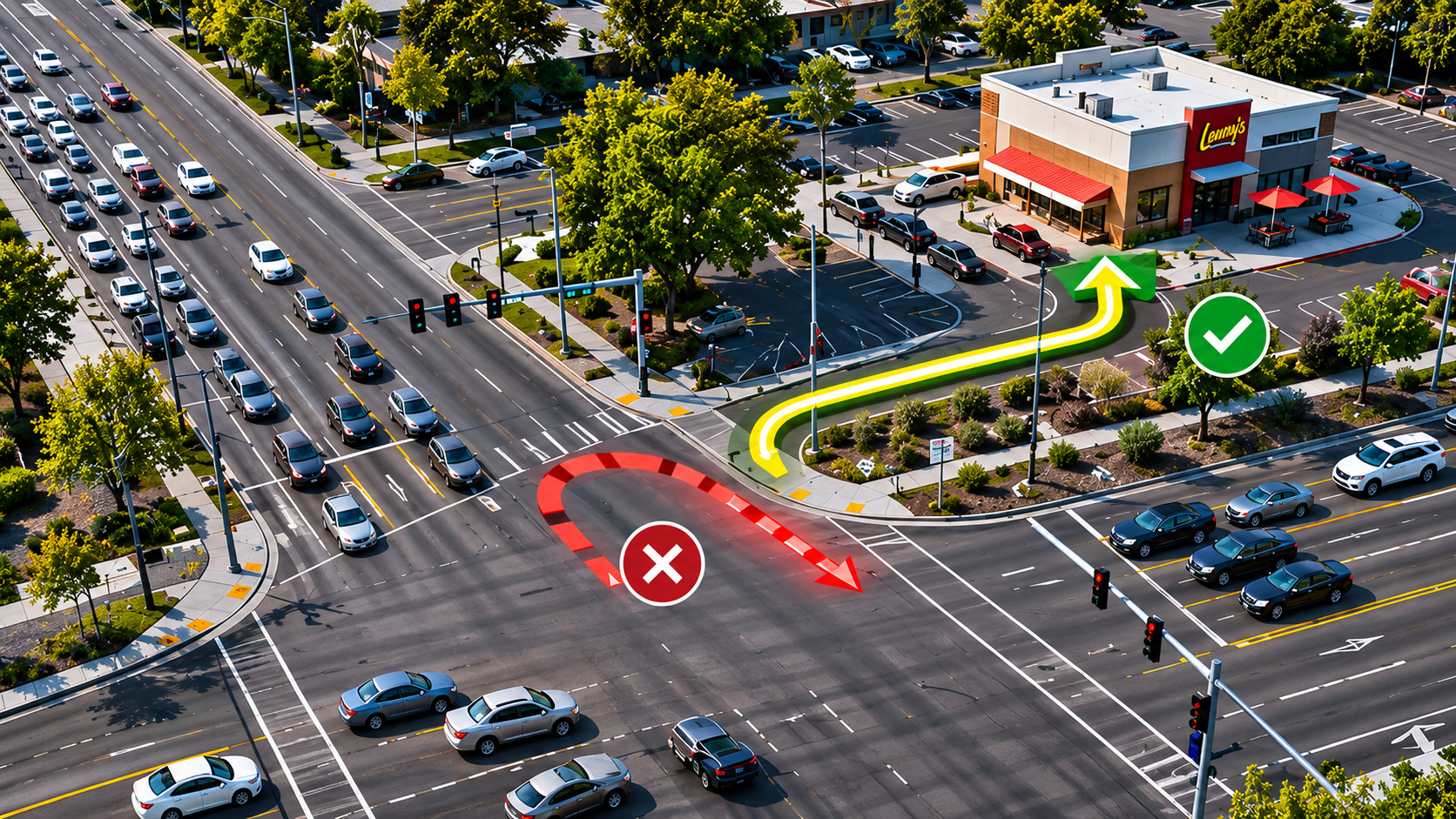


In the competitive quick-service restaurant (QSR) industry, high traffic volumes don’t always translate into higher sales. Difficult turns, congestion, signal delays, and limited access can discourage customers from visiting even the most visible locations. By evaluating roadway friction alongside traditional site selection metrics, QSR brands can better understand customer convenience, identify stronger locations, and improve drive-thru performance.
For QSR brands, site selection has traditionally focused on a familiar set of metrics:
- Traffic counts
- Population density
- Household income
- Nearby retail activity
- Competitor locations
These factors remain important. But they only tell part of the story. A location can sit on a busy roadway, serve a large population, and still underperform expectations. Why? Because customers do not buy from locations they cannot easily access. Increasingly, the difference between a successful drive-thru location and an underperforming one comes down to something many brands fail to measure effectively:
Roadway friction.
Roadway friction refers to the conditions that make it harder, slower, or less convenient for customers to enter and exit a location. Left turns across traffic, congested intersections, long signal delays, difficult ingress points, construction activity, complicated median designs, and peak-period congestion can all create friction that discourages visits.
For QSR brands competing for convenience-driven customers, roadway friction may be just as important as visibility, demographics, or traffic volume. The brands that understand access may gain a significant advantage in site selection, competitive analysis, and store performance.
What Is Roadway Friction?
Roadway friction is any transportation condition that increases the effort, time, uncertainty, or inconvenience associated with reaching a location. Consumers consistently choose convenience. When customers are deciding between two coffee shops, two burger restaurants, or two chicken concepts, the easier location often wins. Factors that create roadway friction include:
- Long traffic signal delays
- Difficult left turns
- Median barriers
- Excessive congestion
- Limited ingress and egress
- Construction zones
- Complicated parking lot access
- Queue spillback from nearby intersections
- Poor drive-thru circulation
Each small inconvenience reduces the likelihood of a visit. Collectively, these factors can materially impact store performance.
Why Traffic Counts Don’t Tell the Full Story
One of the most common mistakes in retail site evaluation is assuming that higher traffic counts automatically create stronger locations. High traffic volume creates visibility. It does not automatically create accessibility. Consider two restaurant sites.
Site A
- 60,000 vehicles per day
- Major arterial roadway
- Dense trade area
Site B
- 35,000 vehicles per day
- Moderate traffic volume
- Easier access and lower congestion
Many site selection models would initially favor Site A. However, if customers face multiple signal cycles, difficult turns, and excessive congestion merely to enter the drive-thru, actual visit potential may be significantly lower than expected. Meanwhile, Site B may convert a higher percentage of passing traffic because it is simply easier to access. For convenience-oriented businesses, accessibility often matters as much as exposure.
Why Drive-Thru Access Has Become More Important
The Drive-Thru Is Now the Front Door
For many QSR brands, most transactions now occur through the drive-thru. Consumers increasingly prioritize:
- Convenience
- Speed
- Ease of access
- Travel time
- Reduced friction
A customer may spend less than three minutes making a purchase decision. If reaching a restaurant adds five extra minutes of delay, many customers simply choose an alternative. This means that transportation conditions directly influence revenue opportunities. The traditional site-selection question:
“How many vehicles pass this location?”
is increasingly being replaced by:
“How easily can those vehicles become customers?”
Friction Point #1: Left-Turn Difficulty
The Hidden Revenue Killer
One of the biggest access challenges for QSR locations is requiring customers to make difficult left turns. Consumers consistently prefer simpler driving decisions. A restaurant location that requires:
- Crossing multiple lanes of traffic
- Waiting through several signal cycles
- Navigating inconsistent traffic gaps
may lose customers to locations that can be accessed through easier right-in movements. This becomes especially important during breakfast and evening commute periods when congestion is highest. Two locations may have identical demographics and traffic volumes yet generate significantly different customer behavior because one is easier to enter.
Friction Point #2: Signal Delay
Every Minute Matters
Signalized intersections play a major role in access quality. When vehicles spend excessive time waiting at signals, the perceived inconvenience of visiting a location increases. This issue becomes particularly important for:
- Coffee concepts
- Breakfast restaurants
- Fast-casual brands
- Convenience-oriented dining
Customers often make spontaneous decisions. Additional delay may be enough to redirect visits elsewhere. Brands that evaluate signal performance near locations gain a deeper understanding of actual consumer accessibility.
Friction Point #3: Congestion and Reliability
Predictability Drives Consumer Choice
Consumers value predictability almost as much as speed. A location that consistently takes five minutes to reach may be preferred over a location that sometimes takes three minutes and other times takes fifteen. Variability creates uncertainty. Roadway congestion often affects:
- Lunch traffic
- Evening peak periods
- Weekend activity
- Event-related travel
Understanding travel-time reliability helps brands evaluate how roadway conditions influence customer behavior across different times of day.
Friction Point #4: Competitive Accessibility
Why Consumers Choose the Easier Option
QSR brands rarely compete in isolation. Customers often choose between multiple options that offer similar products, pricing, and service levels. In these situations, accessibility can become the deciding factor. Imagine two competing restaurants located within a mile of one another.
One requires:
- Two signalized intersections
- A difficult left turn
- Heavy congestion
The other offers:
- Direct access
- Simple turning movements
- Minimal delay
The easier location may capture demand that demographic models alone cannot explain. Transportation intelligence helps brands evaluate not only their own accessibility but also the accessibility of nearby competitors.
Roadway Friction and Site Selection
Looking Beyond Demographics
Demographics remain important. But transportation conditions increasingly separate high-performing and underperforming locations. QSR brands evaluating expansion opportunities should consider:
Accessibility Metrics
- Travel-time reliability
- Turn complexity
- Access restrictions
- Signal performance
Traffic Flow Characteristics
- Peak-period congestion
- Directional traffic patterns
- Commuter movement
- Weekend travel trends
Visit Convenience
- Ease of entry
- Ease of exit
- Drive-thru circulation
- Parking lot accessibility
The best site is often the one customers can reach most easily, not necessarily the one with the highest traffic count.
How Transportation Intelligence Creates Better Decisions
Measuring the Customer Journey Before the Purchase
Transportation intelligence provides a broader understanding of customer behavior by examining how people move through road networks. This allows brands to evaluate:
- Whether customers are likely to pass a location
- Whether they can conveniently access it
- Whether congestion discourages visits
- Whether alternative locations offer easier access
- Whether future roadway changes may improve or reduce performance
Instead of measuring traffic alone, brands can begin measuring customer convenience. That creates significantly more actionable insight.
Why Existing Stores Can Benefit Too: Transportation intelligence is not just useful during site selection. Existing restaurant networks can also benefit. Brands can identify:
Underperforming Locations: Store performance may be influenced by accessibility challenges rather than operational issues.
Roadway Improvement Opportunities: Signal timing, access modifications, and roadway redesigns sometimes improve access conditions.
Construction Impacts: Major construction projects can temporarily increase roadway friction and affect customer demand.
Competitive Threats: Changes in transportation infrastructure can shift accessibility advantages between competing locations.
Understanding these factors helps operators make more informed decisions across the entire portfolio.
Frequently Asked Questions
What is roadway friction?
Roadway friction refers to transportation conditions that make it harder, slower, or less convenient for customers to reach a location. Examples include congestion, difficult turns, signal delays, construction, and limited site access.
Why is roadway friction important for QSR brands?
QSR customers prioritize convenience. If accessing a location becomes difficult or time consuming, customers often choose a competing location with easier access.
Do higher traffic counts guarantee stronger restaurant performance?
No. High traffic counts increase visibility, but they do not guarantee accessibility. Many high-volume corridors create access challenges that reduce customer conversion.
What transportation factors affect drive-thru performance?
Signal delay, congestion, left-turn difficulty, ingress and egress design, travel-time reliability, and nearby roadway conditions can all influence drive-thru usage.
How can transportation intelligence improve site selection?
Transportation intelligence helps brands evaluate actual customer accessibility, roadway friction, travel behavior, congestion patterns, and competitive access advantages beyond traditional demographic analysis.
The Future of QSR Site Selection Is About Convenience
For decades, restaurant site selection focused on where people lived, worked, and traveled. Those factors remain important. But today’s competitive environment requires a deeper understanding of how customers reach a location. The reality is simple: Consumers do not experience traffic counts. They experience convenience. They experience delay. They experience difficult turns, congestion, and travel time uncertainty.
For QSR brands, understanding roadway friction may become one of the most important competitive advantages in site selection, market planning, and store performance optimization. Because the best location isn’t always the one with the most traffic. It’s often the one with the least friction.