
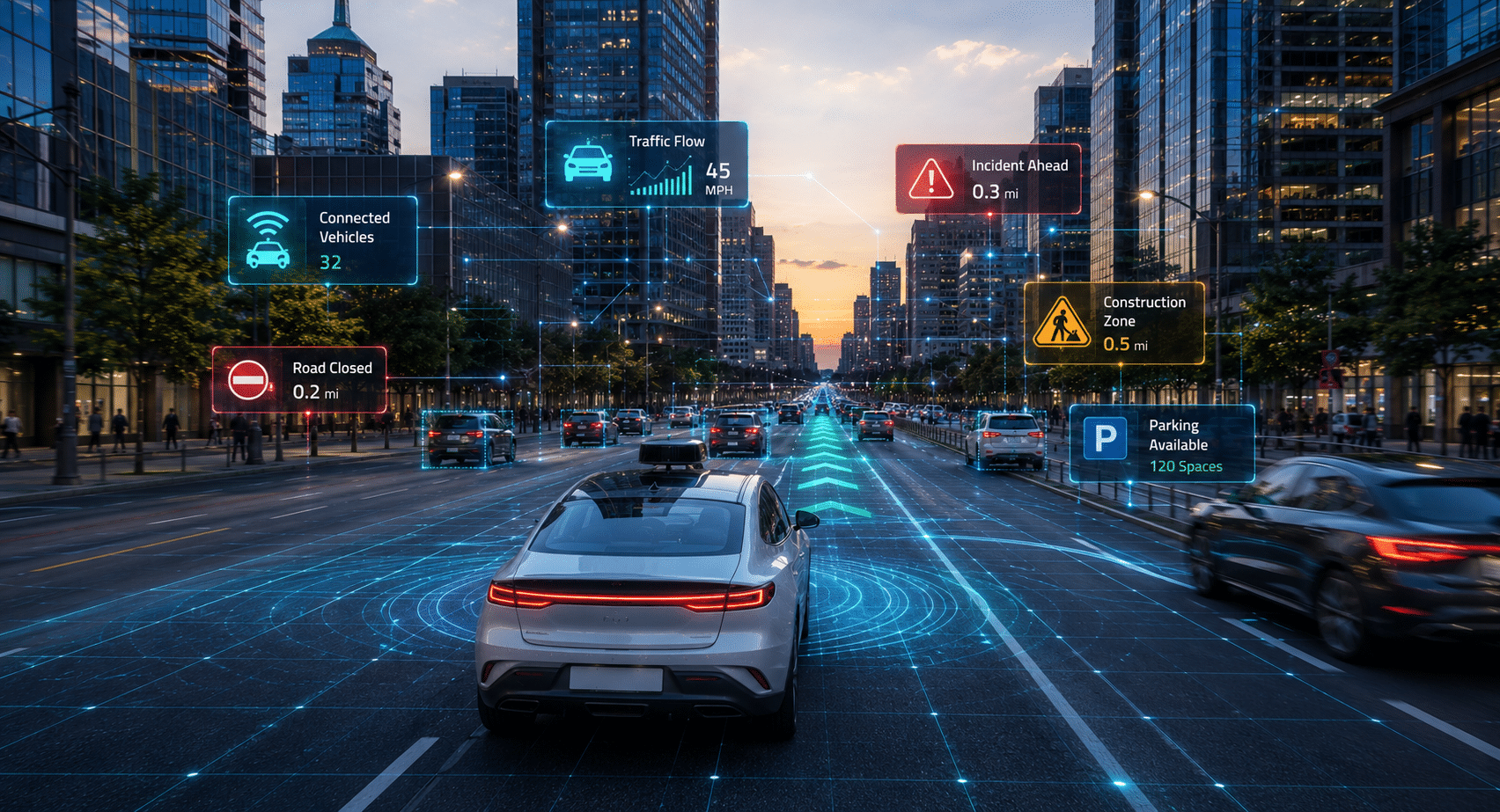


Autonomous vehicles (AVs) don’t just rely on sensors, they rely on context. Cameras, lidar, and radar interpret the world in real time, but without a broader understanding of what lies ahead of the journey, even the most advanced systems operate with an incomplete picture. That’s where critical road data becomes essential.
At INRIX, we provide the platform and data foundation that helps AV companies move beyond isolated perception and into a complete understanding of what’s happening on the road. Think of it as a continuously updating grid of intelligence, one that captures how transportation networks function across time, geography, and conditions.
A Global, Always-On Data Collection Platform
INRIX powers some of the largest mobility data ecosystems in the world. Our platform ingests data from hundreds of millions of connected vehicles, devices, and infrastructure sources globally, creating a model of how people and goods move. This process captures:
- Vehicle speeds and travel times across millions of road segments
- Trip movements and origin-destination patterns
- Parking, curb, and stopping behavior
- Incidents, disruptions, and road conditions
This scale matters. Autonomous systems require not just accuracy, but statistical confidence and that only comes from massive, continuously refreshed datasets. With coverage spanning thousands of cities across more than 60 countries, INRIX provides the breadth and depth AV companies need to operate at scale.
From Raw Signals to Structured Intelligence
Modern mobility data is noisy and fragmented. A single road segment may be represented differently across vehicles, cities, and mapping systems. INRIX transforms these disparate inputs into normalized, production-grade datasets that AV developers can trust.
This includes:
- Real-time and historical traffic speeds and travel times
- Roadway attributes and topology
- Incident, construction, and disruption data
- Curbside activity and parking availability
- Trip and behavioral insights
The result is not just data, it’s a consistent, machine-readable layer of intelligence that can be directly integrated into AV stacks, simulation environments, and routing systems.
Why INRIX Data Stands Apart
Not all mobility data is created equal. What differentiates INRIX is the combination of scale, diversity, and temporal depth.
- Scale: Billions of data points per day provide statistical reliability, even for rare or complex scenarios.
- Diversity: Data is aggregated across OEMs, fleets, mobile devices, and infrastructure, reducing bias and filling gaps that any single source would miss.
- Consistency: Decades of investment in data cleansing and normalization ensure that inputs behave predictably across geographies.
- Continuity: Persistent collection creates a longitudinal view of the road network, not just snapshots in time.
- Depth: Understanding not just that there’s a road closure but when it’s actually starting and stopping allows for more accurate route planning.
For AV companies, this means fewer blind spots, better model training, and more robust performance in the real world.
A Persistent Memory of the Road Network
One of the biggest challenges in autonomy is handling edge cases, the unusual, the infrequent, and the unpredictable. These are precisely the scenarios that are hardest to capture with vehicle sensors alone. INRIX’s historical data acts as a memory layer for the road network, capturing how conditions evolve over time:
- Recurring congestion patterns by time of day and day of week
- Seasonal and event-driven traffic shifts
- Locations with elevated crash risk or erratic driving behavior
- Dynamic curb usage and stopping patterns
With years of historical data across global markets, AV developers can train models on real-world variability, not just controlled test conditions. This leads to better prediction, safer navigation, and more resilient systems.
Enhancing Safety Through Contextual Awareness
Safety is the defining challenge for autonomous mobility. While onboard systems detect immediate hazards, broader datasets help identify risk patterns at scale. By incorporating insights such as high-risk intersections, frequent braking zones, or corridors with elevated incident rates, AV systems can proactively adjust behavior, slowing down earlier, rerouting, or applying additional caution where it matters most. In this way, the data collection grid doesn’t just support navigation, it actively contributes to safer decision-making.
Bridging Vehicles and the Real World
Autonomous vehicles don’t operate in a vacuum, they operate in cities shaped by policy, infrastructure, and human behavior. INRIX bridges this gap by integrating data from both the vehicle ecosystem and the built environment. This includes:
- Real-time impacts of road closures, construction, and events
- Curbside regulations and usage dynamics
- Multimodal interactions with pedestrians, cyclists, and transit
- City-specific traffic patterns and constraints
By providing a shared layer of intelligence between vehicles and infrastructure, INRIX enables AV systems to operate more harmoniously, and more effectively, within real-world environments.
Built for Scale, Delivered in Real Time
INRIX delivers its data through scalable, cloud-based platforms and APIs, enabling seamless integration into AV development and operations. Teams can:
- Train and validate models using large-scale historical datasets
- Run simulations with realistic traffic and behavioral patterns
- Continuously update systems with fresh, real-world insights
With high-frequency updates and low-latency delivery, AV platforms can stay synchronized with constantly changing road conditions.
Powering the Next Generation of Autonomous Mobility
Autonomous vehicles represent a fundamental shift in transportation, but they cannot succeed on sensors alone. They require a persistent, large-scale understanding of how mobility works. INRIX provides that foundation. By delivering billions of data points each day, spanning years of historical context and global coverage, we create a true data collection grid for autonomy, one that transforms fragmented signals into actionable intelligence.
In a world where edge cases define outcomes and safety is paramount, that broader perspective is critical. It’s how AV systems move from reactive to predictive, and from experimental to scalable.