
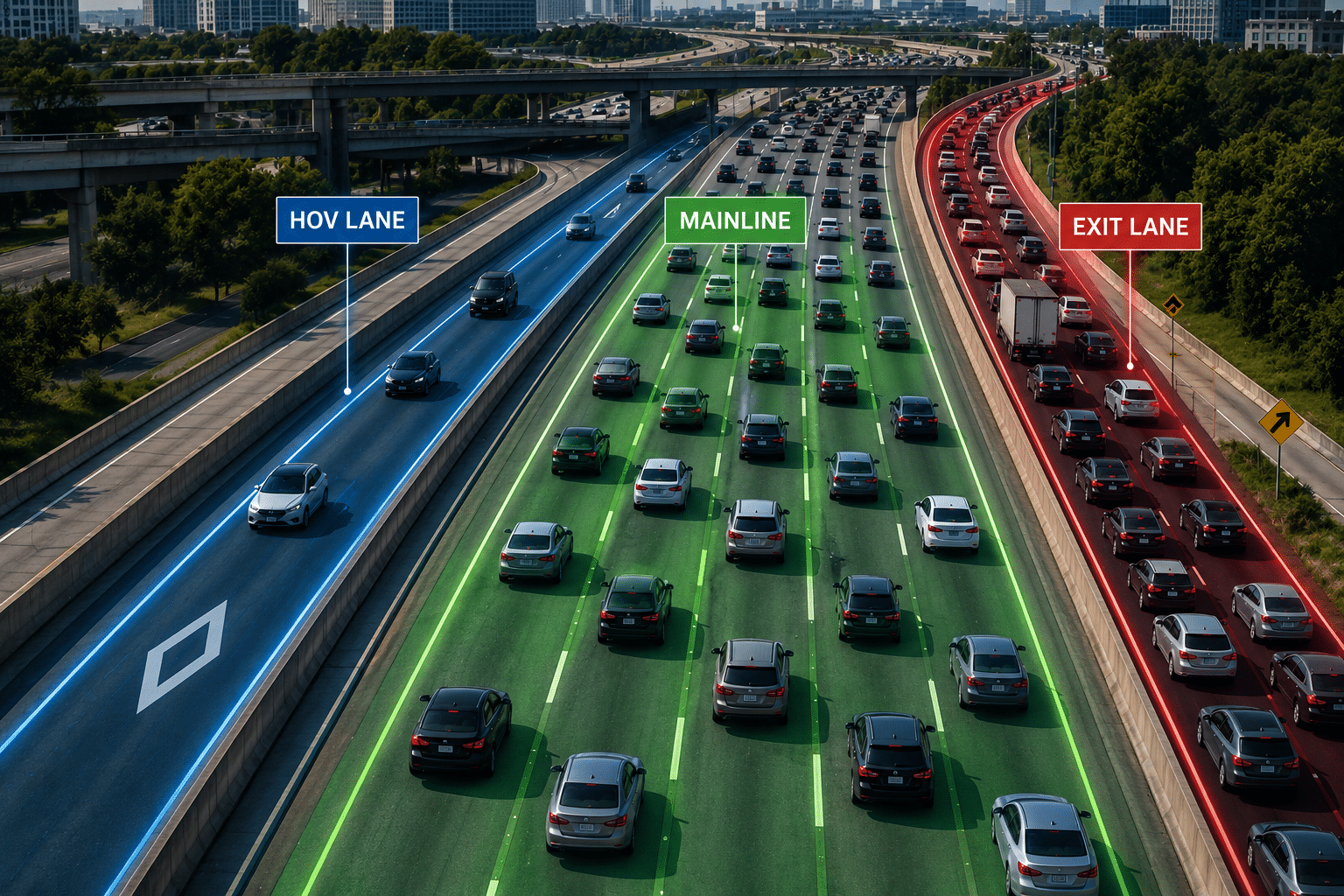


Transportation agencies have long understood a simple truth: not all lanes are created equal.
From high-occupancy vehicle (HOV) lanes to exit ramps and reversible corridors, roadway lanes operate under different conditions, experiences, and outcomes. Yet until now, most traffic speed data treated them as if they were the same.
That changes with the introduction of Special Lanes for Speeds, a major advancement in how transportation agencies and mobility providers understand and act on traffic conditions.
What Are Special Lanes for Speeds?
Special Lanes for Speeds provide lane-level speed visibility within INRIX’s traffic data offering separate speed measurements for distinct lane types on the same roadway segment. These include:
- HOV lanes – reporting speeds for non-barrier-separated carpool lanes
- Exit lanes – capturing queue and slowdowns upstream of off-ramps
- Reversible roadways – reflecting directional changes based on time-of-day operations
Historically, speed data aggregated all lanes into a single value even when one lane was moving at 60 mph and another was stopped. With Special Lanes, those differences are no longer hidden. This is a shift from average road speed to actual lane experience.
Why This Matters
Modern road networks are increasingly dependent on managed and specialized lanes to improve flow, safety, and reliability. These lanes are designed to operate differently providing faster travel, managing congestion, or supporting transit and carpool use. But until now, the data behind them didn’t reflect that nuance. Special Lanes solves critical visibility gaps:
- True Traffic Conditions – When a freeway backs up at an exit, the slowdown is often isolated to exit lanes while through traffic continues moving. Without lane-level visibility, that nuance is lost. Special Lanes allow agencies to:
-
- Separate through traffic vs. exit congestion
- Identify localized bottlenecks
- Avoid overestimating system-wide delays
- Travel Time Accuracy – INRIX data shows that Special Lanes significantly enhance ETA and travel time estimation, translating into better traveler information and routing decisions especially in:
-
- Stop-and-go urban traffic
- High-speed freeway corridors
- Complex routing conditions
- Smarter Traffic Management- Lane-level insights unlock new operational strategies to help agencies move from reactive monitoring to proactive control:
-
- Managing reversible lanes dynamically
- Adjusting messaging around exit congestion
- Supporting managed lane performance tracking
Real-World Use Cases
- DOTs and Traffic Operations Centers
- Identify exit-specific queue buildup before it impacts mainline flow
- Evaluate HOV lane performance vs. general purpose lanes
- Monitor reversible roadway effectiveness during peak shifts
- City Urban Mobility & Planning Teams
- Understand how dedicated lanes (bus, HOV) perform in real conditions
- Evaluate corridor design and geometry impacts
- Prioritize infrastructure investments or redesigns
- Navigation, Routing, and Fleet Providers
- More precise lane-level data improves route optimization
- Fleets can avoid exit-lane bottlenecks and unreliable segments
- Routing algorithms can better reflect real “driver experience”
- Safety and Incident Management
- Detection of back-of-queue conditions in exit lanes
- Awareness of sudden speed differentials between lanes
- Early identification of high-risk congestion scenarios
Helps Customers Deliver Better Outcomes
At its core, Special Lanes is about turning complexity into clarity. Customers gain:
- More accurate travel times – better reflecting real-world conditions
- Higher-resolution analytics – enabling deeper insights without additional data collection
- Improved decision-making – from operations to long-term planning
- Better customer experiences – for drivers, fleets, and transit riders
And importantly, this capability is built into the existing INRIX Speeds ecosystem delivered through the Real-Time Traffic API with enhanced data fields and modernized outputs.
A Step Toward the Future of Traffic Intelligence
The transportation industry is evolving from static, averaged metrics toward dynamic, high-resolution intelligence. Special Lanes for Speeds is a foundational step in that transformation reflecting a broader shift from:
- Segment-level to lane-level understanding
- Reactive analysis to predictive insights
- Incomplete views to full network visibility
And it enables a clearer picture of how roads actually function, lane by lane, moment by moment.