


In Part 1 of the Transparency as a Product Feature series, “Transparency as a Product Feature: Introducing INRIX Speeds Updates,” greater visibility into traffic data was explored as a way to help customers better understand the conditions INRIX products represent.
Part 2 continues that conversation by looking at Special Lanes and why revealing the different traffic conditions happening within the same roadway is another important step toward greater transparency. When we think about traffic congestion, we often talk about roads. But in the real world, we experience lanes.
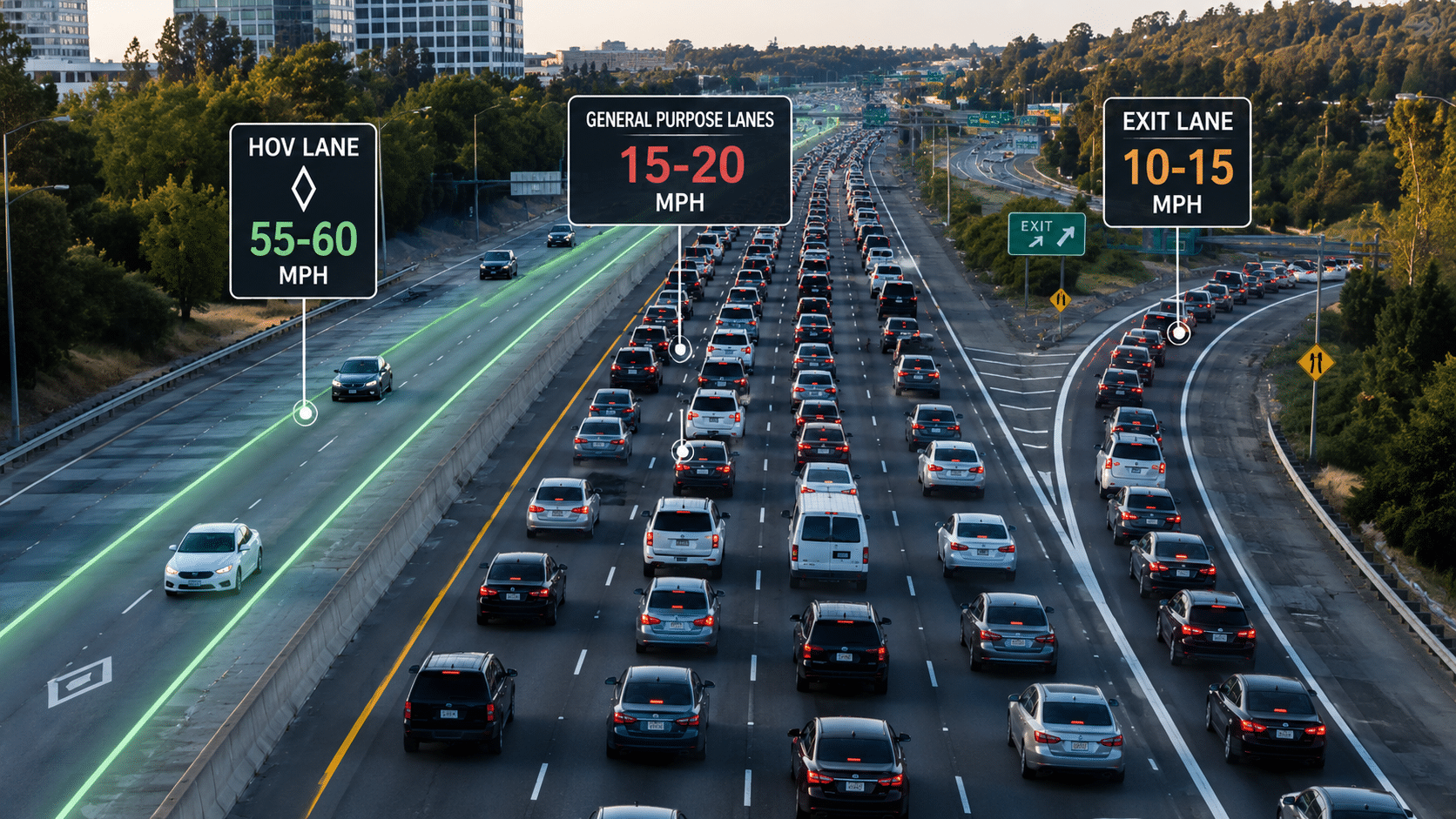
Anyone who has sat in stop-and-go traffic while watching an adjacent HOV lane move freely understands this intuitively. The same roadway can contain multiple, fundamentally different traffic conditions at the same moment. Yet most traffic data products have historically represented those conditions with a single speed value on any given roadway segment.
That simplification is a practical one. It also hides important information.
With the introduction of Special Lanes in INRIX Traffic Intelligence, we’re taking a step toward exposing those differences directly in our traffic data. What makes this launch interesting isn’t just that we report additional speeds. It is how those speeds are generated—and why different lane types require fundamentally different approaches.
The Problem with a Single Speed
Traditional segment-based traffic reporting assumes a road segment has one representative speed.
In reality, that assumption breaks down:
- An HOV lane may be moving at 50-60 mph while adjacent general-purpose lanes crawl at 20 mph.
- An exit lane may be queuing upstream, while through traffic continues normally.
- A reversible roadway may change direction entirely based on time of day.
When all of this activity is compressed into a single speed measurement, important operational insights disappear. The result is a gap between what people experience and what the data can explain.
Special Lanes were designed to help close that gap.
Not Every Special Lane Is Created the Same
One of the most common misconceptions about lane-level traffic information is that all lane types can be derived from map data alone. They cannot.
In fact, Special Lanes consists of two very different technical problems.
HOV and Exit Lanes: A Traffic Detection Challenge
For non-barrier-separated HOV and exit lanes, the challenge isn’t knowing that a lane exists.
The challenge is determining whether that lane is behaving differently from the surrounding roadway—and measuring that difference accurately.
To accomplish this, INRIX analyzes probe observations to identify distinct traffic behaviors occurring within the same roadway segment to distinguish traffic moving in special lanes from traffic moving in adjacent mainline lanes. We are not simply reading an HOV attribute from a map and assigning it a speed.
We are using observed traffic behavior to determine whether the lane exhibits a unique speed pattern, and then reporting that condition when sufficient signal exists. If probe observations indicate no meaningful difference between the special lane and surrounding traffic, the system may treat them similarly.
The same principle applies to exit lanes.
Exit-lane congestion often develops independently from adjacent freeway traffic. Queueing can extend upstream into the main corridor while through traffic remains relatively unconstrained. That distinction matters.
The value of HOV and exit lane reporting comes from the ability to observe and quantify different traffic conditions occurring within the same roadway segment—not simply identifying that those lane types exist.
Reversible Roadbeds: An Operational State Problem
Reversible facilities represent a different challenge altogether.
Unlike HOV and exit lanes, the primary question isn’t whether traffic within a lane is moving differently than adjacent traffic.
The question is whether the facility is currently available for travel in a particular direction.
Special Lanes addresses this by introducing reversibility status reporting, indicating whether a roadway is operationally Open, Closed, or in Transition.
From an engineering perspective, this is less about separating traffic streams and more about representing roadway state accurately.
A reversible facility can legitimately support traffic in one direction during the morning commute and the opposite direction during the evening commute. Ensuring that routing, speeds, and traversability align with that operational reality is the core problem being solved.
This is why it is useful to think of Special Lanes as two complementary capabilities:
- Probe-derived lane-speed detection for HOV and exit lanes.
- Operational-state intelligence for reversible roadways.
Both improve traffic understanding, but they do so through different technologies and different signals.
Why This Matters for Transportation Agencies
For transportation agencies, lane-specific visibility can reveal conditions that segment-level speeds often mask.
An HOV lane that consistently outperforms adjacent travel lanes may indicate a policy success. An exit lane that regularly experiences severe queueing could point to operational or geometric constraints. A reversible roadway’s state can influence routing, traveler information systems, and corridor performance analysis.
Most importantly, these insights become available through the same traffic infrastructure customers already use.
Instead of replacing existing workflows, Special Lanes adds additional context where meaningful lane differentiation exists. The standard segment speed remains available while lane-specific intelligence is surfaced alongside it.
A Better Representation of How Roads Actually Work
Transportation networks are becoming more specialized. Managed lanes, HOV facilities, reversible corridors, dynamic operations, and lane-specific traffic management strategies are increasingly common across North America and beyond.
Traffic data should evolve to reflect that reality.
Special Lanes represents a move away from treating every segment as a single operating condition and toward representing the roadway the way people and transportation professionals experience it: as a collection of lanes that may behave very differently from one another.
Sometimes the most valuable improvement in traffic intelligence isn’t collecting more data. It is in revealing information that was previously hidden inside a single number.