


After more than a decade of rising roadway deaths, new federal data offers a rare piece of encouraging-yet-still-sobering news: traffic fatalities in the first half of 2025 have fallen back to pre-pandemic levels.
According to preliminary estimates from the National Highway Traffic Safety Administration (NHTSA), 17,140 people died on U.S. roadways from January through June, resulting in fatality numbers not seen this low since 2019 and 2020. While this still represents an unacceptably high toll, it signals that the surge in dangerous driving and severe crashes during the pandemic years may finally be letting up.
The fatality rate, fatalities per 100 million vehicle-miles traveled (VMT), peaked at 1.33 during the first half of 2021. The latest official figures now show the fatality rate at 1.06 during the first half of 2025, its lowest point in over a decade and close to 2014 levels.
How the U.S. Compares Internationally
Despite this progress, the U.S. still trails far behind peer nations. In the U.K., traffic fatalities have steadily fallen, even throughout the pandemic years. Fatalities dropped from 1,752 in 2019 to 1,602 in 2024, an 8.5% decline. When adjusted for the amount people drive: the U.K. recorded just 0.47 deaths per 100 million VMT in 2024, less than half the U.S. rate. Germany stands between the two at 0.64.
Much of Western Europe failed to see similar increases in fatality rates as the U.S. Often these differences are chalked up to improved road quality, generally lower speeds (with exceptions), tougher licensing requirements, and generally smaller vehicles. Yet throughout COVID-19, behavioral differences like speed and distraction likely play a key factor in the relatively high fatality rate seen in the U.S.
Speed: A Persistent and Preventable Killer
Speed remains one of the largest contributors to severe roadway crashes. NHTSA estimates that speeding is involved in nearly 29% of all road deaths. That reality has prompted several U.S. cities like Los Angeles, New York, San Diego, and Tucson, to reduce speed limits, often by substantial margins.
Early evidence shows mixed but meaningful outcomes: in Santa Monica, for example, speed reductions varied by corridor, with Michigan Avenue seeing a sharp drop in excessive speeding along an area that also saw roadway redesigns, while Colorado Avenue showed smaller but still noteworthy declines.
The Rise of Automated Speed Enforcement
As speeding continues to be a major factor in the severity of crashes, more cities are turning to automated enforcement technology. Minneapolis, Baltimore, and newly authorized California cities like San Francisco have begun using speed cameras in an effort to deter high-risk driving.
Abroad, major European cities like Dublin, Amsterdam, Madrid, and Barcelona have expanded camera networks as part of broader Vision Zero strategies.
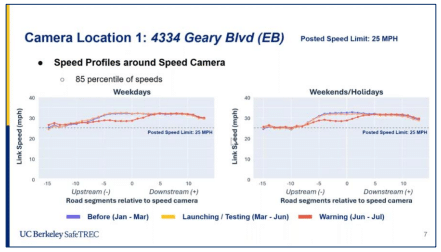
Recent research from UC Berkeley’s SafeTREC, using INRIX data, examined driver behavior near new speed cameras in San Francisco. Their study found that speeds decreased at camera locations, but detouring increased, as some drivers attempted to avoid enforcement zones. Researchers also mentioned that speeding tended to resume once drivers passed the monitored area.
Commentary
The decline in fatalities and fatality rates in 2025 is undoubtedly encouraging. But sustaining this progress will require continued investment in safer road design, stronger enforcement strategies, and data-driven policymaking – not sound bites or theories. The U.S. may be on the right trajectory, but closing the safety gap with other nations will take a sustained commitment to making our roadways safer.
For more information visit the INRIX 2025 Global Traffic Scorecard.