
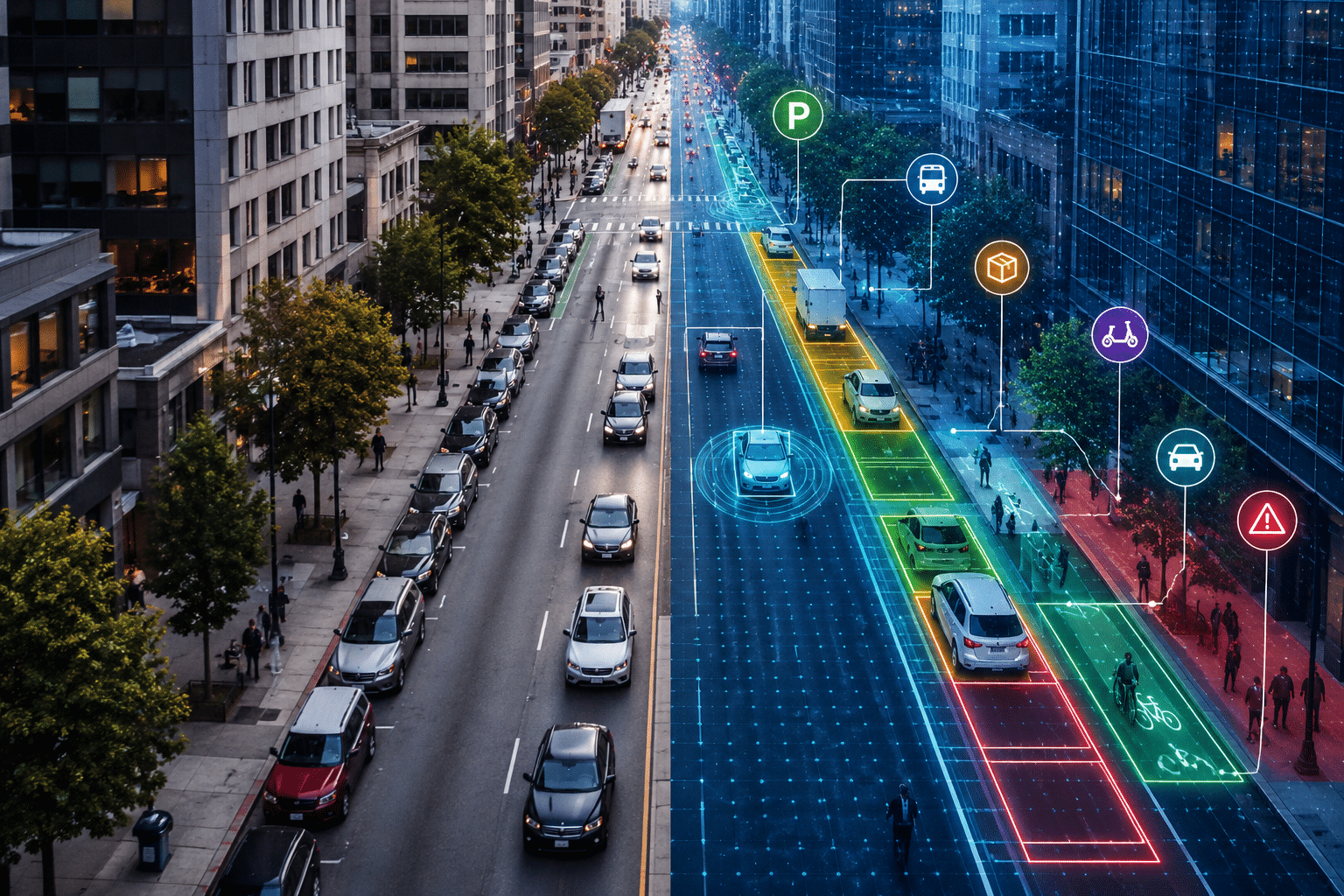


Cities don’t have a parking problem.
They have a visibility problem, and it’s costing them real money.
Across the U.S., curb space is one of the most valuable and underutilized public assets. It supports everything from delivery and transit to ride-hailing and micromobility. Yet most cities still manage it with incomplete data, static rules, and outdated assumptions.
The result?
Lost revenue. Reduced compliance. Increased congestion. And frustrated residents who feel like the system isn’t working.
The Illusion of “Full Means Working”
A full block doesn’t mean your curb is performing well.
In fact, it often signals the opposite.
A curb can show high occupancy and still:
- Fail to generate optimal revenue
- Limit turnover
- Create bottlenecks for delivery and transit
- Contribute to unsafe conditions for pedestrians and cyclists
Without understanding who is using the curb, when, and for how long, cities are left guessing.
Where Revenue Actually Gets Lost
Most cities leave money on the curb in three critical ways:
- Mispriced curb space
Pricing is often set based on outdated studies or uniform assumptions. But demand varies:
- By block
- By time of day
- By land use
Without this granularity, cities underprice high-demand areas and overprice others, reducing both revenue and utilization.
- Poor turnover
High occupancy doesn’t equal high performance. A curb occupied by all-day parking in a high-demand zone can reduce:
- Retail activity
- Delivery efficiency
- Overall economic output
- Ineffective enforcement
Enforcement teams often operate without real-time prioritization. That means:
- Violations go unchecked in critical areas
- Resources are spent where they deliver less impact
What Leading Cities Are Doing Differently
Forward-thinking cities are shifting their approach, from managing parking to managing curb performance.
Instead of relying on a single data source, they combine:
- Measured occupancy –from sensors or ground truth data
- Modeled occupancy – network-wide insights
- Digital curb policies – machine-readable rules governing use
This combination enables a continuous loop:
Observe → Adjust pricing or policy → Measure → Improve
Real Benefits for Cities and Their Communities
When cities get this right, the impact extends far beyond parking.
- Increased revenue without raising taxes: By aligning pricing with real demand, cities unlock revenue from existing assets—without adding infrastructure.
- Better service for residents and businesses: Improved turnover means, easier parking access for drivers, faster deliveries for businesses, and reduced congestion.
- Improved safety and mobility: Better managed curbs reduce double parking, blocked bike lanes, and conflicts and intersections.
- Stronger outcomes for constituents: The beneficiaries become the people that the cities serve; residents, retailers, logistics operators, and transit users.
Turn Curb Visibility Into Action With INRIX Curb Analytics
Cities know the levers they can pull: adjust pricing, change time limits, rethink loading zones, and prioritize enforcement.
The challenge is knowing where to act first.
INRIX Curb Analytics gives cities a clearer view of curb demand by combining measured and modeled occupancy insights with digital curb policy data. The result is broader visibility into where demand is highest, when pressure builds, and where current policies may not align with real-world use.
With these insights, cities can quickly identify opportunities to optimize pricing, improve turnover, and focus resources where they can have the greatest impact.
The Shift Cities Must Make
The biggest mindset change is this:
Stop asking, “Is the curb full?”
Start asking, “Is the curb delivering results?”
That shift, from static parking management to dynamic performance management, is what separates cities that struggle from those that lead.
Learn more about INRIX Curb Analytics.