



Rising fuel costs do not always produce an immediate, broad pullback in driving.
Earlier INRIX analysis, in “Fuel Prices Are Rising, But Driving Behavior Looks Steady” found that, at the national level, U.S. trip totals and average speeds were still tracking normal weekly patterns in early 2026 even as regular gasoline rose sharply, from $2.937 per gallon in the week ending February 23 to $4.120 in the week ending April 6. That is why the signal in this Northern California chart matters: it looks less like a wholesale retreat from commuting, and more like a selective adjustment on the least sticky day of the workweek.
Rising fuel costs are not moving the whole week
The most useful way to frame this pattern is cautiously. Broadly speaking, the national story has still been one of resilience: fuel prices have risen quickly, but the kind of all-week behavioral shift that INRIX previously observed around the 2022 price extremes has not yet reappeared across U.S. consumer driving data. In that context, a Friday-only softening in one of the Bay Area’s longest-distance commuter sheds is notable precisely because it is narrower than a classic demand shock.
“What stands out here is not a collapse in commuting, but a margin adjustment,” said Nathan Nekrews, INRIX Data Analyst. “When price pressure shows up in a hybrid labor market, it does not have to empty the roads across the whole week. It can show up first on the day that is already easiest for employers and workers to flex.”
What we are seeing in the eastern supercommuter basin
The graph below tracks weekday morning commute trip volumes originating in San Joaquin, San Benito and Contra Costa counties and heading towards San Francisco / Silicon Valley job centers. Visually, the key point is straightforward. Monday-to-Thursday trip volumes remain within a familiar band. Speeds also continue to oscillate within a normal range rather than showing a clear structural break. Friday, by contrast, was already the lightest day of the week and appears to step down further from March onwards by a low-single-digit percentage, widening the weekday gap.
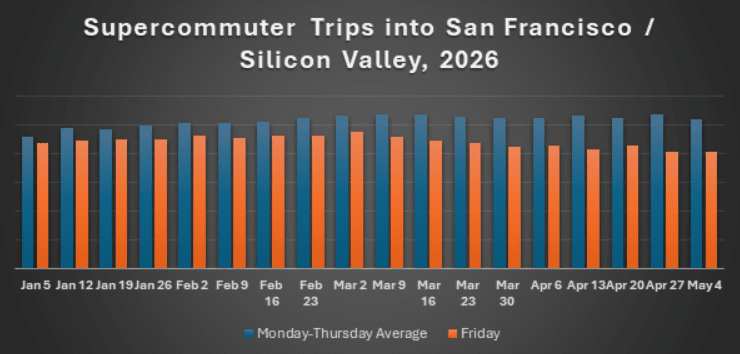
Earlier in 2026, Fridays averaged roughly 9% fewer commute trips than the rest of the workweek. In recent weeks, that gap has widened to nearly 20%.
That distinction matters because the data does not point to a broad retreat from office commuting. If workers were broadly abandoning in-office work, the decline would likely appear across all weekdays. Instead, the drop is concentrated on the day already most flexible in the hybrid work schedule.
Why Friday is the first day to flex
Friday was already the weakest office-attendance day before fuel prices surged. Placer.ai data reported by The Real Deal found that only 14.1% of office visits in San Francisco occurred on Fridays, the lowest Friday attendance in the city comparison it cited, while Tuesdays through Thursdays had become the preferred in-office pattern. More recent Placer research says the same thing at the national level: office attendance remains concentrated around Tuesday and Wednesday anchor days, while Fridays stay consistently soft.
WFH Research similarly reports that remote work remains most common on Mondays and Fridays. That built-in flexibility makes Friday the easiest commute day to cut. Instead of employers formally reversing return-to-office policies, workers can simply skip one especially expensive trip. Placer.ai’s office-attendance research also found that shorter commutes correlate with more frequent office visits, suggesting long-distance commuters are naturally more sensitive to rising fuel costs.
Why this pattern shows up around San Joaquin, San Benito and Contra Costa
The geography is important. Stanford and INRIX research published in 2024 found a 32% increase in commutes longer than 75 miles across major U.S. metro areas after the pandemic, driven partly by hybrid work. Average journeys in the study exceeded two hours each way.
Bay Area housing costs have pushed many workers farther from employment centers, creating established supercommuter corridors through Stockton, Modesto, Hollister and eastern Contra Costa County. Federal transportation research identified these areas as major sources of outbound Bay Area commuters.
Recent reporting from the San Francisco Chronicle also described Altamont Pass commutes from San Joaquin County as increasingly unsustainable amid rising gas prices and return-to-office mandates.
The timing lines up with a real fuel shock
The timing closely aligns with a major fuel-price spike in spring 2026. The U.S. Energy Information Administration said crude oil and petroleum product prices increased sharply in the first quarter of 2026 following military action in the Middle East on February 28 and the subsequent de facto closure of the Strait of Hormuz. In California, regular gasoline rose from $4.441 per gallon in the week ending February 23 ,2026 to $5.769 in the week ending April 6, 2026. In the San Francisco metro series, regular gasoline rose from $4.566 to $5.781 over the same span.
By mid-May, the pressure was still plainly visible in daily averages. AAA showed California regular at $6.147, San Francisco at $6.303, and San Jose at $6.133. For workers making long, repeat journeys from places like Stockton, Hollister or eastern Contra Costa into Bay Area employment centers, that is more than enough to change the weekly arithmetic of showing up in person.
“The key point is that these commuters do not need a 2020-style switch back to full remote work for behaviour to move,” said Nathan Nekrews, INRIX Data Analyst. “If the cost shock is large enough, one extra day at home can be the rational adjustment — and Friday is already where the hybrid system is loosest.”
What this probably means
The most careful headline, then, is not that Bay Area employers have publicly reinstated a formal “work from home Friday” policy in response to fuel prices. Publicly available reporting still points more towards quiet flexibility than top-down reversals. Business Insider reported in March that most U.S.-based employers were unlikely to alter in-office requirements quickly, but also quoted a San Francisco-based executive saying that when gas prices spike, commuting “effectively becomes a pay cut” and that remote work or flexible scheduling can make a meaningful difference. The same article also highlighted at least one employer that expanded home-working allowances after workers complained about commuting costs.
That interpretation also fits broader national evidence. The Wall Street Journal reported in May that work-from-home days increased from 24.7% of days in February 2026 to 26.9% in March 2026, even as supercommuters were being squeezed by fuel costs. Read together with the Bay Area chart, the most plausible story is not a dramatic reversal of return-to-office policy. It is a deepening of an already established hybrid behavior, concentrated on the day most likely to bend.
For employers, downtown districts and transport agencies, that distinction matters. A Friday-specific softening means the relevant question is not whether offices are “open or shut”, but how the composition of the week is shifting under cost pressure. In a convenience-driven office market where Tuesday and Wednesday remain the anchor days, rising fuel prices may show up less as a broad collapse in attendance and more as a further hollowing-out of the edges of the week.